
Ephemera
Collection Index
Jadu Nath Pal & Family
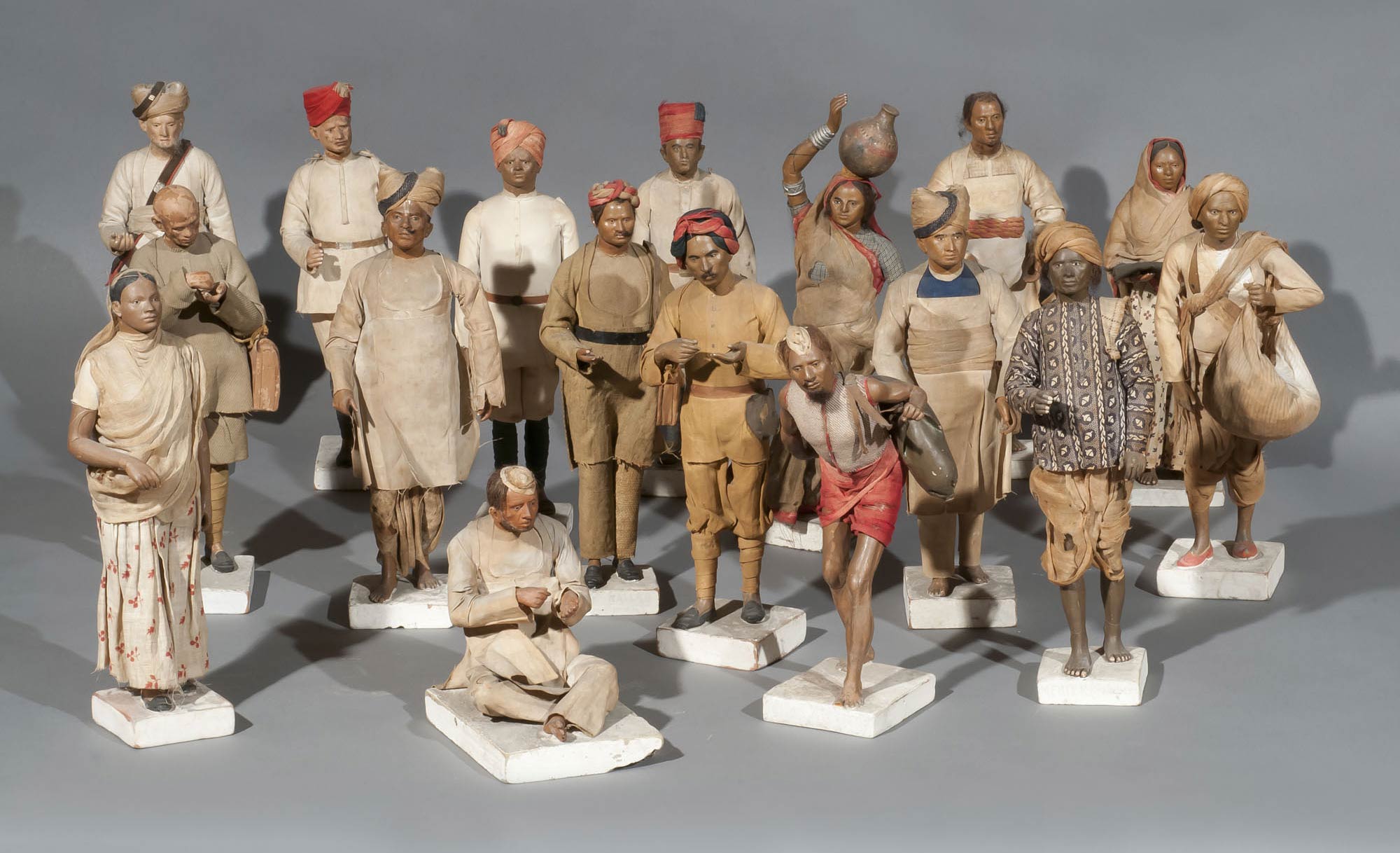
Seventeen models of various trades
-
Krishnanagar
Circa 1850
Tallest 14.5 cms
Seated 26.5 cms
These sculptures are made of air-dried clay mixed with fine fibres, which
might possibly be hair, modelled on a metal armature. Applied textile decoration
has been used, and then painted with a water-based organic paint. Various
areas, such as the eyes, have been varnished, other areas being matt in order
to heighten realism.
The clothes have been woven to fit the scale of the sculpture, so that the
patterns on the various textiles are appropriate. Beards and hair are made
of real human hair.
The wooden plinths on which some of the sculptures stand have been covered
with paper, which has had grit or sand attached to increase the verisimilitude.
In other cases the bases have simply been painted white.
It is felt that the quality of this sculpture would indicate that it is the
work of the Jadu Nath Pal family. "... The figures made by them have
acquired great celebrity, and they have repeatedly gained medals and certificates
in most of the International Exhibitions held since 1851. There is considerable
delicacy and fineness in their work; the figures are instinct with life and
expression, and their pose and action are excellent." (T.N. Mukharji,
Art Manufactures of India, 1888)
A well-known series of miniature figures produced in India from unfired clay, appropriately clothed and in many instances represented carrying out their respective secular or ritual duties, enjoyed a period of particular popularity on the world stage in the nineteenth century when they were appropriated as illustrative devices in museum displays and international exhibitions. Over the previous half-century or more they had emerged as products of a dynamic industry that responded to changes in taste as well as religious and artistic practice within Indian society, before being taken up by the West to serve new colonial imperatives. There they received perhaps their most enthusiastic reception at the India Museum, established in the headquarters of the East India Company in London in the early 1800s, and surviving beyond the suppression of the Company itself until they were dispersed to a number of other institutions in 1879. From an early appearance at the Great Exhibition in 1851, the figures also became a regular feature of the international exhibitions of the latter part of the century.
Initially they celebrated the traditional crafts and practices of India but gradually were recruited to communicate other messages of Western industrial dominance and perceived artistic and industrial superiority.
Although comparatively few of these figures survive intact in Western collections, the history of their considerable impact on the European stage can be enlarged upon with the aid of the documentary record.
Key aspects of Bombay Presidency terracotta figures include: Production Centers & Styles: Pune (Poona) was a major hub for realistic, often life-like, clay figures, along with workshops in Mumbai. Subject Matter: Figures depicted a wide range of subjects, including water carriers, cooks, washermen, postmen, musicians, and various tradespeople. Technique: Many were made from painted terracotta or unfired clay, sometimes utilizing metal armatures for support. They were often painted with mineral colors and, in some cases, dressed in actual fabric. Significance: These figures served as ethnographic representations, becoming popular as souvenirs and in museum collections like those at the Chhatrapati Shivaji Maharaj Vastu Sangrahalaya (CSMVS). Artistic Influence: The Bombay School of Art (established 1857) (J.J. School of Art) encouraged the use of traditional Indian motifs in ceramic work, including influence from Ajanta cave frescoes. Adam Calvert Bentley plus five Prominent 19th-century makers in the region included artisans like Bapuji Supekar, Kaluram Govandi, and Sitaram Joshi.